
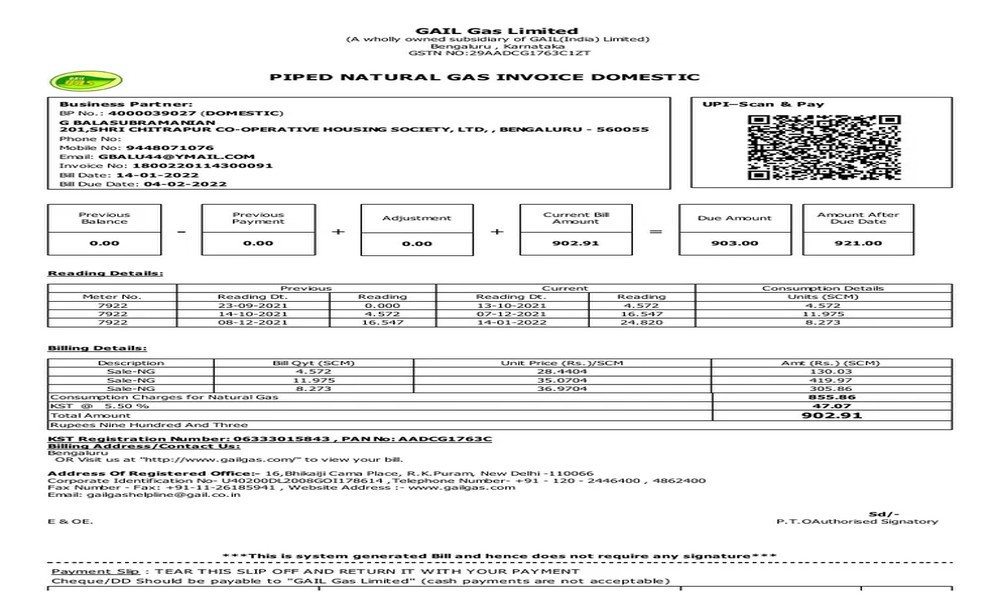
Customers are usually lost in gas bills with their technical terms and several charges. Proper reading of a bill assists businesses to follow the cost of energy and identify billing mistakes. This guide indicates the major sections available on commercial gas bills.
Learning more about gas bill
Understanding your gas bill basics
A gas bill indicates the amount of gas that a business consumes as well as the cost of supply. It comprises usage fees, fixed fees and taxes. Understanding enables to prevent confusion in billing and enhances financial planning. Most business gas bills have the following basic components:
- Usage charges: A charge on the quantity of gas used during a billing period typically given in units such as a megajoule or cubic meter.
- Charges of supply: A fixed day charge which is used to maintain the gas network and supply gas to business premises irrespective of the level of usage.
- Billing period: The specific dates which indicate the date of gas usage and billing which can be used to trace the patterns of consumption over time.
- Tariff rates: The rates imposed on usage of the gas which can vary with the place of use, the contract or the time of usage.
- Taxes and other charges: Government charges or service fees to be added to the bill which influences the amount to be paid at the end.
What’s on your gas bill explained
A gas bill in the case of business has all the information that aids in tracking costs. Every section will give an understanding of trends of use and cost. Close examination assists in detecting abnormal changes and making superior decisions. The important sections of a normal gas bill are highlighted as follows:
- Account details: Account number, business name and service address to identify the account by account number and billing accuracy.
- Meter readings: Data taken of past and present meters you are using in calculating the total amount of gas consumed in the billing cycle.
- Energy consumption: The total amount of gas consumed was converted into standard energy units to allow even the bills and comparisons.
- Payment summary: A report on the total bill, the amounts that have been charged before, and the outstanding amount outstanding at the end of the billing period.
- Due date and methods of payment: Clarity on when payment is to be made and options to be made like bank transfer and online payment.
How to read your gas bill step by step
Correct reading of a gas bill helps to improve control of costs. Every part is to be checked. This is done to make sure that none of the concealed charges are overlooked. Reading a business gas bill is easy and can be done through the following steps:
- Check billing period: Make sure that the dates are valid according to the expected use cycle, and there is neither overlap nor vacant days.
- Review meter readings: Check the current and past readings to confirm that the calculations of consumption are correct.
- Examine charges: See how the cost elements are composed to know how the overall bill is made up.
- Confirm total amount: Check that everything is adding up and that it is the same amount that is listed as payable.
A look at the frequently asked questions
What is the estimated reading in a gas bill?
An estimated read is where the retailer did not have access to the meter, thus estimating the usage on the basis of usage before.
What is causing the increase in the amount of the gas bill compared to last year?
An increase in usage, the colder weather or a wrong meter estimate can all lead to an increase in the bill.
What can a business do to verify the read on the meter of gas?
Check the closing read put on the bill against the actual one displayed on the gas meter outside the premises.
What is a gas bill benchmark comparison?
There are some bills that indicate the usage that was related to similar businesses and this helps in determining the unusually high usage of the business.