
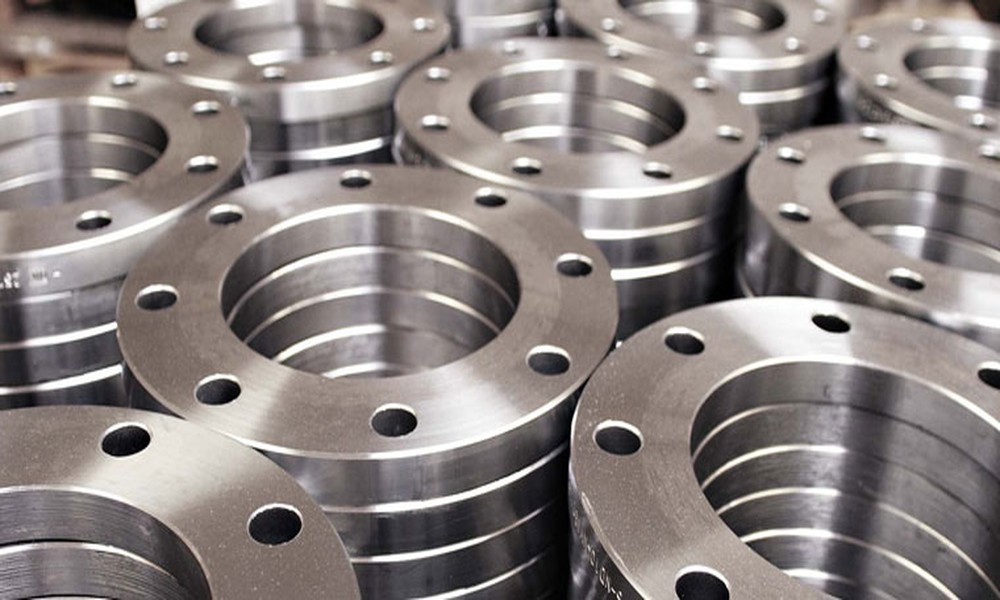
Pipe flanges are among the most fundamental components in industrial pipeline engineering. They provide the bolted, gasketed connection points that allow sections of pipework, valves, pumps, and other equipment to be joined in a way that can be broken apart for maintenance, inspection, or replacement without cutting the pipe.
Understanding the types available, the standards they are manufactured to, and the factors that govern material and size selection is essential for anyone specifying or procuring flanged pipeline systems.
What Flanges Are and Why They Are Used
A flange is a disc or ring of material bolted to the end of a pipe, valve, pump, or other component. Two flanges are brought face to face with a gasket between them and bolted together to create a sealed, pressure-rated joint that can be unbolted and separated at any time without damage to the pipe itself. This breakability makes flanged connections the standard choice wherever maintenance access is a design requirement: at pump connections, at valve installations where future removal may be needed, at equipment interfaces, and at inspection or sampling points throughout a process system. In plastic pipework systems, flanges also allow plastic pipework to be connected to metal equipment that cannot be solvent welded.
Main Flange Types
The most commonly encountered flange types in industrial applications are:
- Slip on flanges are slid over the pipe and welded or bonded in place. Straightforward to fit and widely used in both metal and plastic pipe systems, with PVC and ABS versions solvent cemented to the pipe end.
- Weld neck flanges are butt-welded to the pipe end with a tapered bore matching the pipe internal diameter, producing a strong, stress distributing joint suited to high-pressure and high temperature applications.
- Blind flanges are solid discs with no bore, used to blank off the end of a pipe run or vessel nozzle, allowing future extension by simply replacing the blind with a flanged spool piece.
- Backing ring flanges (stub flanges) are used with loose backing rings in plastic pipe systems. The stub is solvent welded to the plastic pipe and a separate backing ring provides the bolt face, distributing bolt load without stressing the plastic stub directly.
Flange Standards and Pressure Ratings
Flanges are manufactured to published standards that define the bolt hole pattern, face dimensions, and pressure rating. The most commonly encountered in UK industrial pipework are PN-rated flanges under EN 1092, where PN6, PN10, PN16, and PN25 cover most industrial, water, and chemical service requirements.
ANSI/ASME B16.5 class ratings are found on plant with North American engineering influence, and older BS 4504 and BS 10 flanges are still present on existing UK installations. Flanges from different standards are not interchangeable even at the same nominal bore size, as bolt hole counts and circle diameters differ. For plastic pipework systems, a full range of metric PVC flanges and gaskets is available in PN6, PN10, and PN16 ratings.
Gasket Selection
The gasket provides the seal between two flange faces and must be compatible with the medium being handled, the operating temperature and pressure, and the flange face type. Full face gaskets extend across the full flange face and are standard with flat-faced plastic flanges. Ring gaskets sit within the bolt circle and are used with raised face metal flanges. Rubber gaskets in EPDM, NBR, or viton are the most common choice for water, chemical, and general industrial service at moderate temperatures.
Frequently Asked Questions
Can PN10 and PN16 flanges be bolted together?
PN10 and PN16 flanges share the same bolt hole pattern up to certain sizes under EN 1092, so they can generally be mated together; however the joint assembly must be rated to the lower of the two pressure classes, and a gasket suitable for both faces must be used.
What is the difference between a full face and raised face flange?
A flat face flange has a flush sealing face across its full diameter and is standard for plastic flanges; a raised face flange has a slightly elevated central seating area within the bolt circle and is the standard for most steel and cast iron flanges in industrial service.
Do plastic and metal flanges need different gaskets?
Yes. Plastic flanges require full face gaskets to distribute bolt load evenly across the full face; using a ring gasket on a flat-faced plastic flange concentrates load in the centre of the face and risks cracking the flange under bolt tightening.
How do I know which flange standard my existing system uses?
The bolt hole count, bolt circle diameter, and overall flange outside diameter should be measured and compared against EN 1092, ANSI B16.5, and BS 4504 dimension tables; the flange may also be stamped with a standard reference or pressure class marking.
Final Thoughts
Flanged connections are a fundamental part of industrial pipeline design, providing the maintenance access and equipment interface capability that permanent jointing methods cannot offer. Correct specification requires confirming the flange standard and pressure class, the gasket material, and the bolt specification in combination. Mixing standards, under-torquing bolts, or using the wrong gasket type are the most common causes of flanged joint leakage in service, and all are straightforwardly avoidable with accurate specification at the outset.
For engineers and contractors sourcing flanges and associated pipeline components for industrial projects, a comprehensive range covering both plastic and metal options at all standard pressure ratings is available from specialist industrial pipe fitting and valve suppliers.